COLREGs Made ClearFrom First Rule to Confident Decisions at Sea
The Rules of the Road, taught rule by rule, with narrated lessons, scenarios and quizzes.
View COLREGs Made ClearRadar plotting
From First Echo to Confident Collision Avoidance
From first echo to confident collision avoidance.
All our courses take you from complete novice to Day Skipper and Yachtmaster shore-based theory level. They are designed for everyone that wants to improve their knowledge levels.
This course takes you from a first radar echo to a plotted decision in restricted visibility. You learn the controls, the plotting triangle, CPA and TCPA, and the avoiding action Rule 19 allows.
The early blocks are how radar works and how to set up the display: tune, gain, sea and rain clutter, range scales, the EBL and the VRM. You then compare head-up, north-up and course-up, relative and true motion, and echo trails. Later you match echoes to the chart and sort false echoes from real ones.
The plotting blocks build the triangle from the points O, A and W, then find CPA, TCPA, aspect and the target's true course and speed. You plot the effect of an alteration under Rule 19, set a parallel index line, and see where ARPA and AIS mislead. The last blocks are small-craft radar and three fog passages on a fictional coast. Each gated block asks for 80% on its quiz before the next one opens. A final assessment of 60 questions covers the whole course.
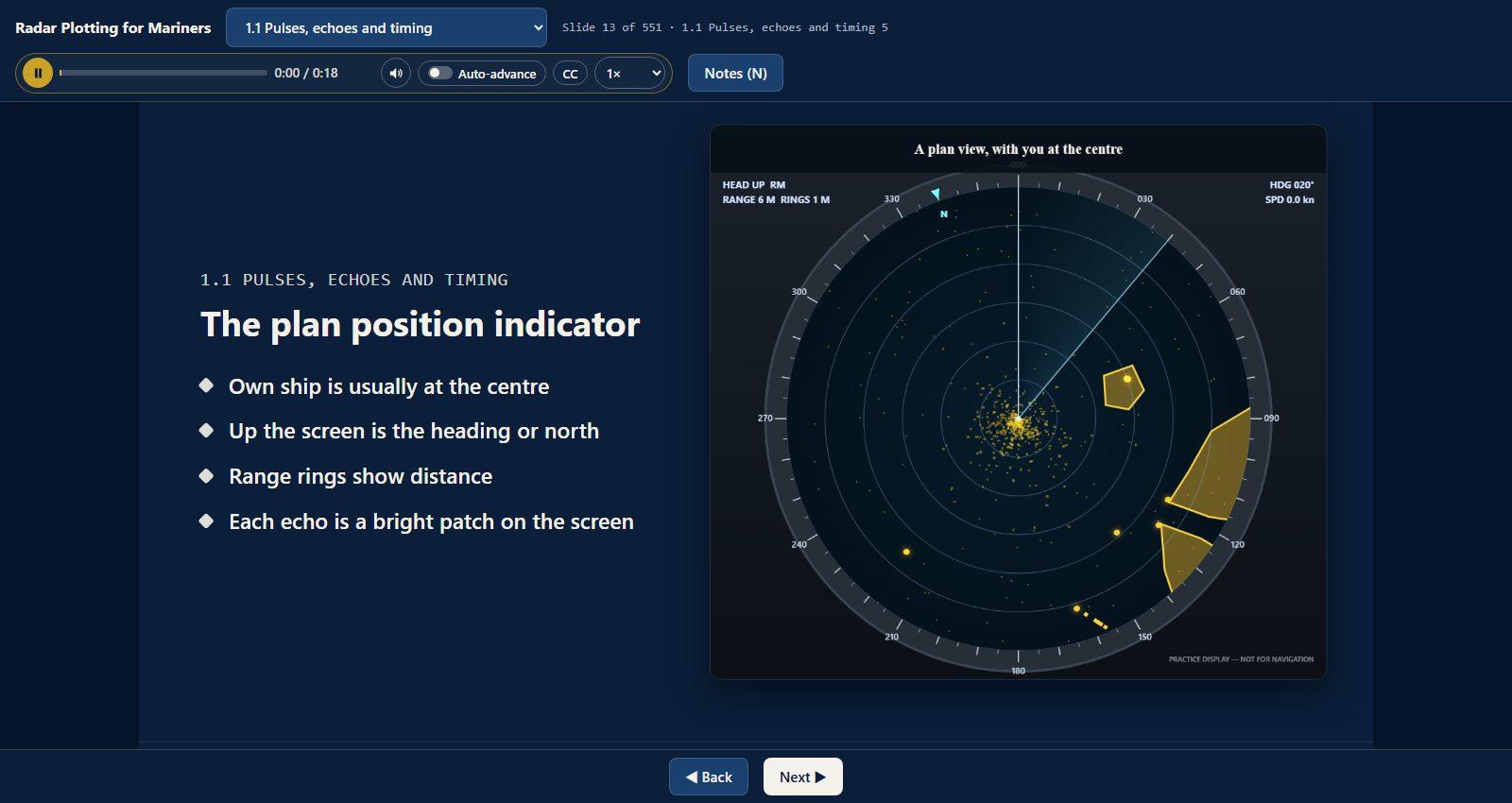
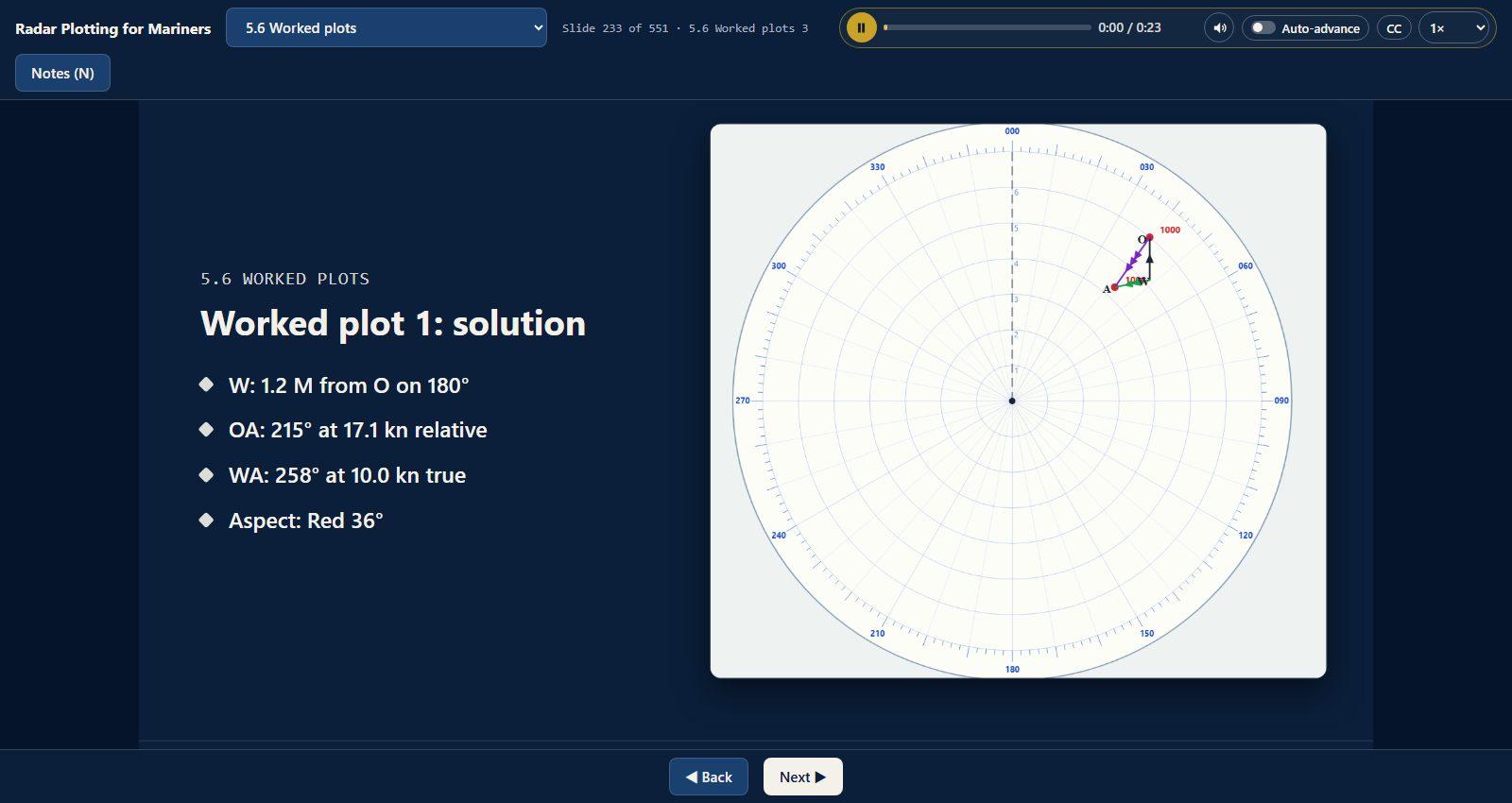
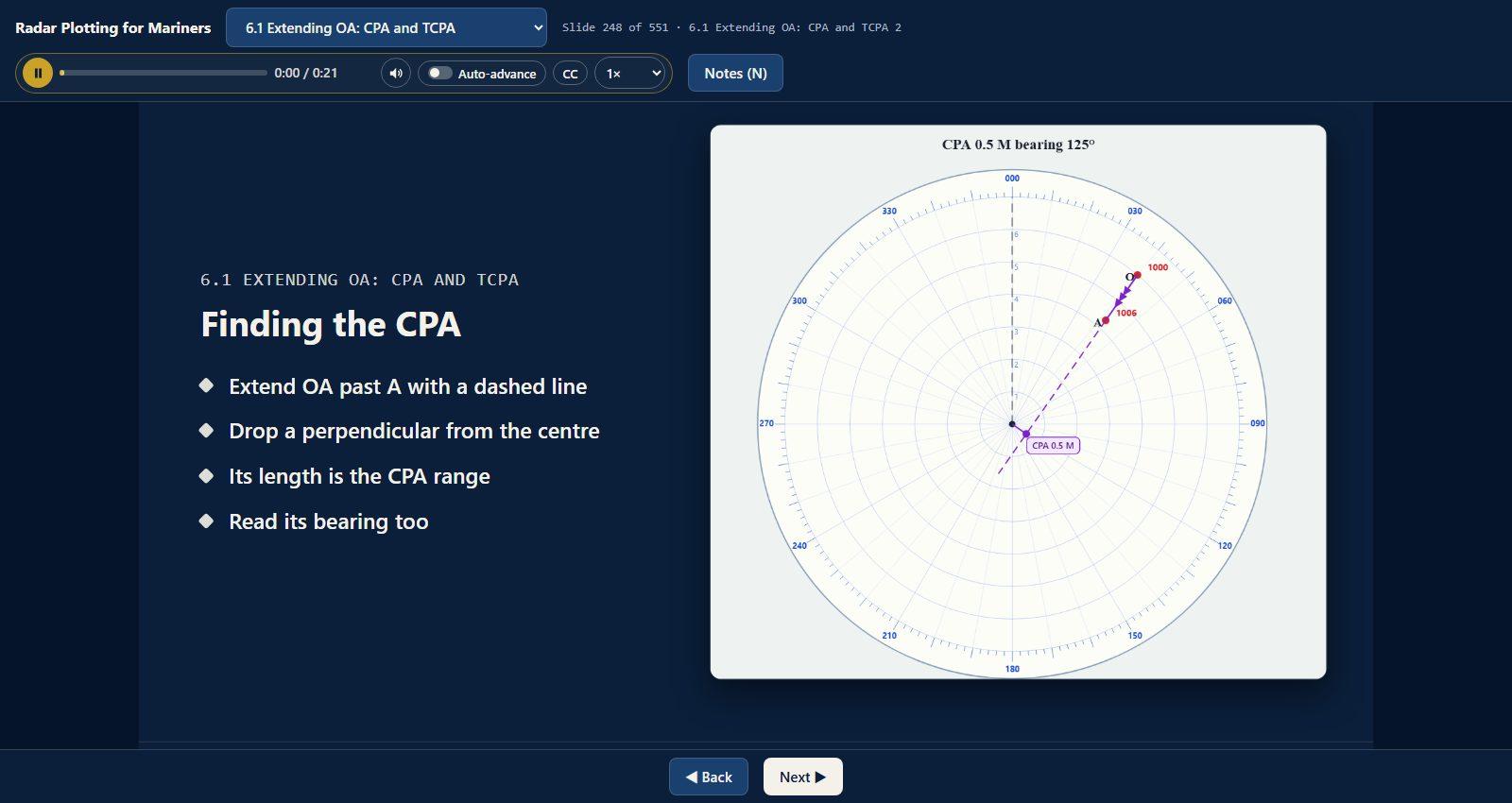
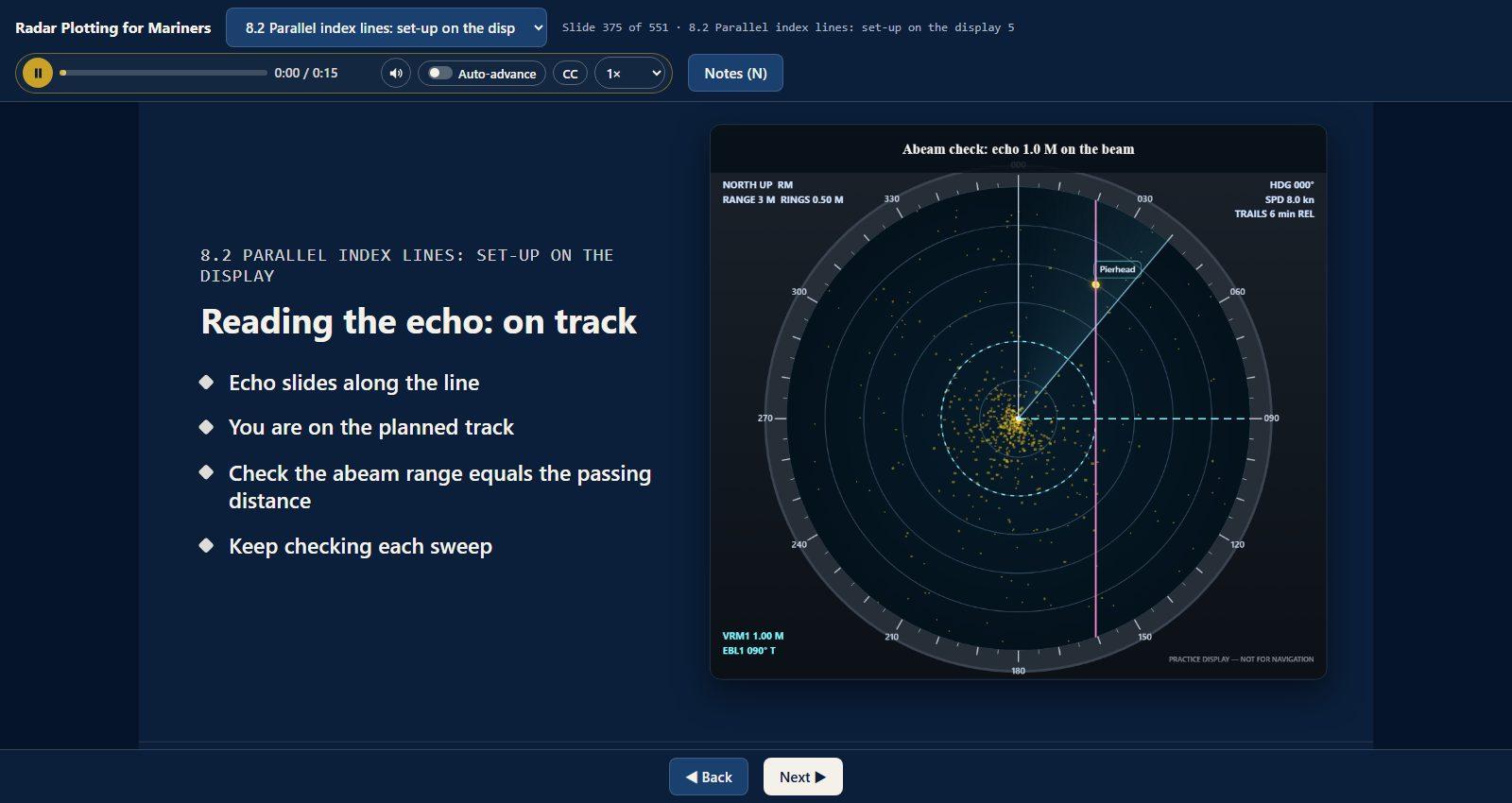
The plotting triangle, CPA and TCPA, and Rule 19, taught as a watchkeeping skill rather than as a list of control names.
A self-paced course for the radar on a yacht: heading sensors, being seen, a short-handed watch and fog drills, as well as the plot.
Rule 19 is also in COLREGs Made Clear. This course is the plotting, the display and the parallel index that sit around that rule.
Self-paced online. Plan for about 15–20 hours. Lessons run in a browser on a laptop, tablet or phone. There is nothing to install. When you finish, Sea Skills Online issues a certificate of completion. That certificate records your study. It is not an STCW, MCA or RYA certificate.
Watchkeepers, yacht crew and officer candidates. Price £39. Checkout creates your account, or signs you in, takes payment through Stripe, and adds the course to your dashboard.
Unlimited free tutor support is included. If a lesson does not make sense, email hello@seaskillsonline.com. There is no extra charge, and there is no limit on how often you write.
How the course works, and the rule that the displays, plots and coastlines are for training.
Pulses, echoes, beam width, radar horizon and what radar cannot see.
Switch-on, tune, gain, sea and rain clutter, range scales, EBL and VRM.
Head-up, north-up and course-up; relative and true motion; trails.
Matching radar to the chart, false echoes and Rule 7 risk of collision.
O, A and W: building the plotting triangle by hand.
CPA, TCPA, aspect and target true course and speed.
Rule 19 in restricted visibility, Rule 8, and plotting the effect of action.
Radar fixes, parallel index lines and pilotage in fog.
ARPA and AIS: what they do, and how they mislead.
Small-boat sets, heading sensors, being seen and fog drills.
Three full fog passages, with every tool in exam mode.
Questions from every block, at least six in ten on a radar picture or a plot. Pass mark 48 out of 60, with 24 hours between attempts.
The radar displays, plots and coastlines are fictional and not for navigation. Rules 5, 6, 7, 8 and 19 are quoted from the International Regulations for Preventing Collisions at Sea, 1972, as amended. Rule text © IMO. Block 9 uses MAIB reports, which contain public sector information licensed under the Open Government Licence v3.0.
No. It is training in radar plotting and Rule 19. Sea Skills Online is not an RYA or MCA training centre, and the certificate is a certificate of completion.
CPA is the closest point of approach. TCPA is the time to that point. The course finds both from the plotting triangle, using the relative line from O through A, then uses them with Rule 19 in restricted visibility.
Not before you start. This course teaches the radar picture, the plot and Rule 19 in restricted visibility. COLREGs Made Clear teaches the collision regulations as a whole, including Rule 19. The two courses do not replace each other.
No. The displays, plots and coastlines are fictional and are for training only.
Each block quiz asks for 80%, which is 5 out of 6, before the next block opens. The final assessment is 60 questions in 75 minutes, with a pass mark of 48, and 24 hours between attempts.